

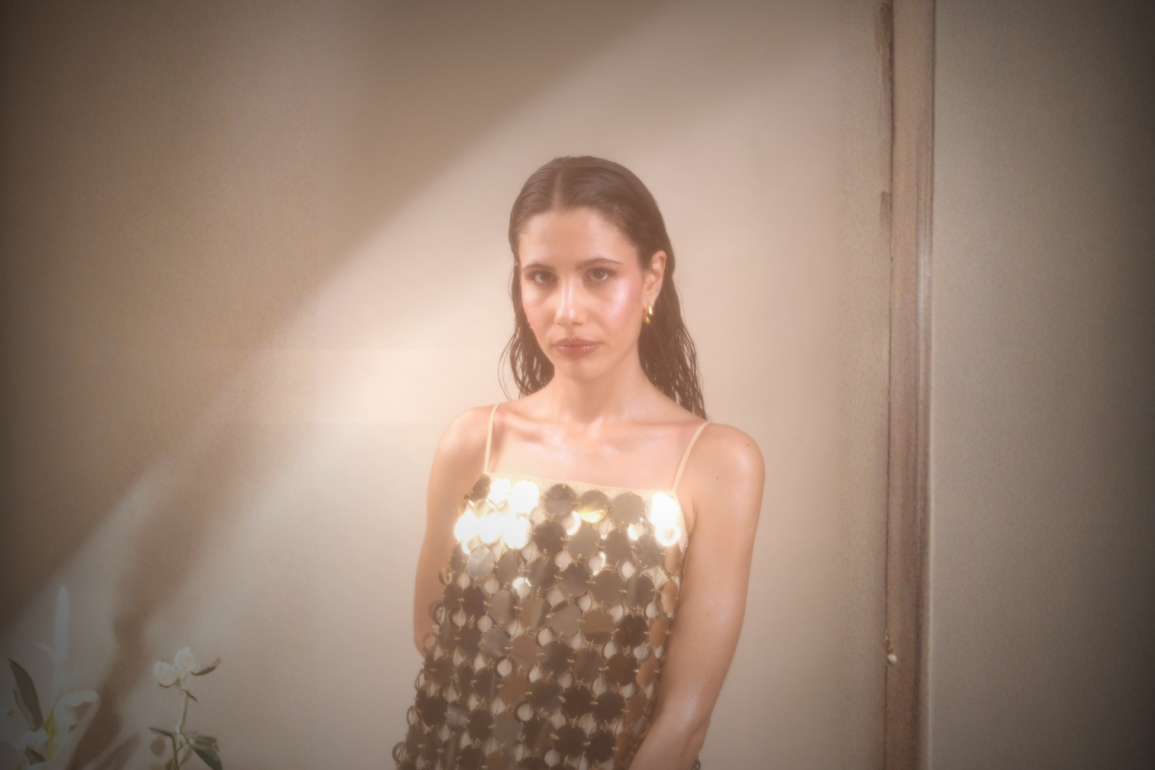
Photo credit: Siouzie Albiach
French artist Elle Valenci creates immersive, genre-defying music blending electro-pop, indie, soul, and R&B. Rising from Lyon’s creative scene, she gained acclaim following collaborations with Lecomte de Brégeot and her breakout hit Perfect Blue. Valenci prioritizes emotion over formula, crafting a unique identity that resonates globally. We spoke with her about her creative process, influences, and the personal stories behind her work.
Listen to her track, ‘Perfect Blue’ while reading the interview below:
How would you describe your musical style and the genres or subcultures that most influence your sound?
My music exists somewhere between different worlds. I grew up listening to electronic music, folk, and a lot of niche artists and underground sounds from the late ’90s and early 2000s. Those influences still resonate deeply in what I create today. Rather than identifying with a specific genre or subculture, I’m guided by emotion and instinct. What inspires me most is the feeling music can provoke and the genuine connection an artist can create through sound. That’s what I try to capture in my own work, something honest, intuitive, and free from boundaries.
Music Creation: Describe the primary setting or environment where your music is conceived. Is it a chaotic, overstimulating studio, a minimalist digital space, a rehearsal room, or a more isolated location?
I tend to create in isolated and somewhat chaotic environments, where inspiration emerges from everyday life and unexpected moments. I don’t have a fixed routine or a specific setting when I start making music. Ideas can come from anywhere, and I follow them instinctively.
I think that’s also what gives my songs their singularity. The lack of structure allows me to capture emotions as they come, and you can hear that honesty and vulnerability in my voice when I begin to sing. My music isn’t born from perfection, it’s born from lived experiences and the emotions attached to them.
When you create, what leads the way – a feeling, a story, or the sound itself?
Emotion always leads the way. The sound comes with it, helping me translate what I feel into something tangible. The story behind each song is a consequence of that process, a natural extension of the emotions and sonic landscapes that emerge while I’m creating.
What’s in your toolkit? Share the gear, gadgets, or software you can’t create without.
These days, I couldn’t create without my computer. Since the very beginning, I’ve been making music in Ableton, and even now I’m constantly discovering new ways to compose and push my ideas further. It’s a tool that has grown with me and evolved alongside my creative process.
But as important as technology is, there’s one thing that’s just as essential, an old notebook filled with thoughts and fragments of stories that become lyrics. It follows me everywhere, gradually filling up as I write about moments I’ve lived through and emotions I want to capture.
Are there any unexpected or dream collaborations hidden in your work?
There are no real “hidden” collaborations in my work in the traditional sense, but I do feel like I constantly collaborate with the artists I listen to. Even if they are not physically present, their influence is always there in the way I build sounds, write melodies, and approach emotion in a track.
As for dream collaborations, I try not to limit myself too much. I’m more drawn to people who create with honesty and emotion, regardless of genre. A true collaboration, for me, is less about status and more about connection and shared sensitivity.
Any side projects you’re working on?
I’m currently finishing a project that follows the natural continuation of my last EP, building on its sonic and emotional direction. At the same time, I’m working on a new acoustic project that explores a more intimate side of my music, which I’m planning to release around 2027.
Who’s an emerging artist you think deserves more recognition right now?
I don’t have a specific emerging artist in mind at the moment, but I’m always discovering new music across different scenes. I think there are many independent artists today who deserve more attention and recognition.
What role does ‘rebellion’ or ‘counterculture’ play in your music? Are you aiming to challenge commercial norms, sonic structures, or societal expectations?
I’m not tied to a specific genre, which makes it hard to place my music in a box. Being independent and still reaching listeners all over the world, with millions of streams without fitting into a commercial standard, feels like a strength and, in a way, a form of rebellion. It’s not something I approach as a statement, but more as a natural consequence of staying true to my own vision.
Who is one non-musical artist (e.g., fashion designer, visual artist, film director) whose work feels sonically synonymous with your sound?

I’m drawn to visual worlds that exist somewhere between darkness and light, where rawness and fragility coexist. There is often a sense of something almost dreamlike, slightly distorted, yet deeply emotional and human. I’m especially attracted to aesthetics that feel both unsettling and beautiful at the same time, where fashion, imagery, and emotion blur into one atmosphere rather than telling something literal.
What aspects of your artistry feel most important to you, for example, your sound, visuals, storytelling, or live performance style?
Above all, it’s the music, followed by the visuals, which help bring it to life and play an important role in my work, as they do for many artists, I think. Today, through social media and the press, we are often expected to project a strong visual identity, and I feel that sometimes it can even take precedence over the music itself.
But before any visual creation, it all starts with the music. The music itself is what takes you on a journey, and everyone is free to escape into their own world through it.
The Future: What is the most exciting and the most terrifying technological development impacting the music industry right now (e.g., AI composition, NFTs, digital distribution models)?
Digital distribution models now allow a certain freedom and make it possible to share music independently. They have had a major impact for artists today, giving them the ability to stay in control of how they release and promote their work without necessarily being tied to a major label.
But if there is one thing that feels truly concerning today, it is AI-generated music. Even if it can technically work, I don’t believe it will ever be able to replace emotion, the raw authenticity of a human voice, or the texture of a real instrument, even in electronic music.
How would you describe the live music environments you feel most connected to? For example, are you drawn more to the energy of massive festival stages, the intimacy of underground warehouse parties or DIY venues, or a mix of both?
I haven’t yet had the opportunity to play at large festivals. However, I’ve been fortunate enough to connect more with intimate venues and underground spaces, where my music tends to fit very well. The proximity with the audience is something I really value in my live performances, as it allows me to share these emotional moments more directly with people.
Famous last words?
Always trust your stars and the energy they guide you with.