

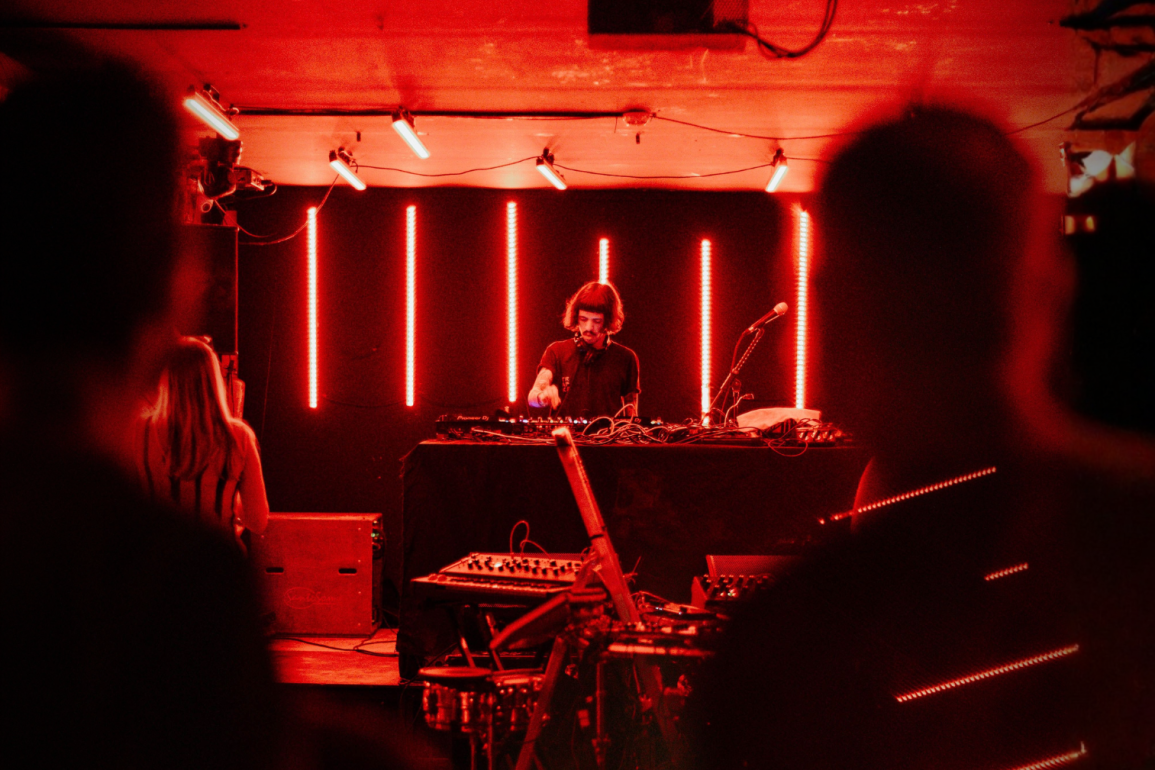
Photo credit: K
London constantly seeks the next big thing, but artists truly develop in intimate spaces before reaching mainstream fame. The city’s underground musicians rely on small, stuffy venues with sticky floors rather than massive arenas. In these rooms, experimentation is expected, and artists refine their sound through a circuit where rough edges are welcomed by active audiences.
In East London, MOTH Club still feels like a beautiful accident. Hidden behind its modest exterior in Hackney, the venue’s gold ceiling streamers and retro interior create an atmosphere that sits somewhere between community hall and dream sequence. There’s little distance between performer and audience here; you can stand close enough to watch songs being figured out in real time. The space has become one of London’s unofficial proving grounds for rising artists, the kind of place where audiences arrive curious rather than committed.
A short journey away sits Oslo Hackney, tucked inside a converted railway station where trains still rumble overhead. The venue has developed a reputation for bridging scenes that don’t always overlap: indie guitar bands, left-field electronic producers and genre-blurring newcomers all passing through the same room. On one night, it feels like a sweaty club show, on another, a carefully guarded secret. The line-up often reads like a prediction of who people will be talking about six months later.
Across the city, Bush Hall offers something different entirely. The Edwardian venue carries a certain elegance: chandeliers, ornate details. The kind of architecture that feels almost too grand for emerging artists. But that contrast is exactly what makes the space work. New acts take to the stage in a room that feels almost historic, turning first headline shows into moments that feel larger than they probably should.
Next, The Windmill in Brixton is perhaps the closest thing London has to a mythical underground institution. Its DIY reputation has become part of modern music folklore. For years, artists and fans have treated it as a laboratory for experimentation, a place where genre boundaries are summarily ignored. The room rewards risk. Bands can be noisy, awkward, strange or unpolished, and still find an audience willing to stay until the end of the set.
East London’s Shacklewell Arms operates with a similar spirit. Small enough to feel personal and unpredictable enough to stay interesting, the venue has long embraced artists sitting just outside the mainstream. Indie, punk and experimental acts collide here with little concern for categorisation. The appeal is the potential for musical discovery that it offers.


Lastly, there’s The Lexington, where the traditional pub downstairs gives way to one of London’s most beloved upstairs rooms. The contrast feels distinctly British: pints and casual conversation below, future cult favourites upstairs. Over the years, it has quietly become a fixture of the indie circuit, a place where fans return not because they know who’s playing, but because they trust the room itself.
These venues are united by a shared sense of permission rather than a specific sound. Across diverse genres, they allow artists to experiment, fail, and grow organically away from the industry’s demand for instant virality.