

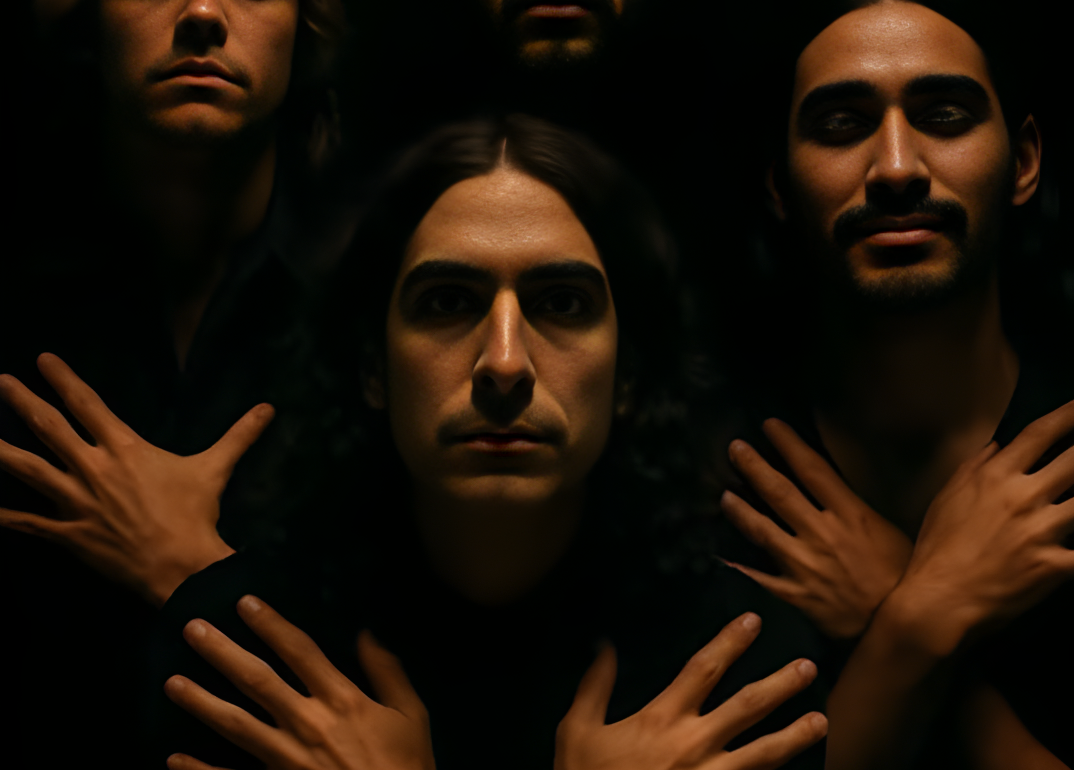
Have you heard of The Velvet Sundown? The name evokes a nod to the resounding legacy of psych-rock stalwarts The Velvet Underground. However, unlike that band, whose history is well documented, the jury is still out on whether The Velvet Sundown is even real.
Less than a month after surfacing online, the psych-rock group has accrued over 550,000 monthly listeners on Spotify, released two full-length albums, and launched an Instagram page filled with AI-generated imagery. Their music is streaming across platforms including Apple Music, Amazon Music, and Deezer, and appears on user-generated playlists as well as algorithm-driven recommendations. However, many listeners have begun to notice that the entire project feels off.
Their bio describes the band as “quietly spellbinding,” using abstract metaphors, like comparing their music to “a scent that suddenly takes you back somewhere you didn’t expect” – the kind of language often associated with large language models. The profile claims the group was formed by four musicians: Gabe Farrow, Lennie West, Milo Raines, and Orion “Rio” Del Mar. None have any public presence online: no social media, no old SoundCloud demos, and no trace of prior artistic activity.
And the track credits on Spotify are just as strange. Every song is credited only to The Velvet Sundown – written by, performed by, and sourced from the band itself. There is no mention of a producer, label, or collaborators. While it is not impossible for a project to be entirely self-contained, it is highly uncommon. Reddit threads examining the band claim there’s “not a shred of evidence” that any of the members exist.

This has led to widespread speculation that the band’s music is AI-generated – possibly created using tools like Suno or Udio, both of which can produce convincing, if somewhat generic, genre pastiches. According to MusicRadar, The Velvet Sundown “bears the unmistakably lo-fi veneer of a Suno creation.”
Yet, there is no definitive proof that the music is machine-made. And that ambiguity is exactly the issue.
Streaming platforms like Spotify and Apple Music do not require artists to disclose whether content is generated by AI. This lack of transparency is already influencing how listeners engage with new music. Deezer, which flags content suspected to be AI-generated, now displays a note on the band’s page: “Some tracks on this album may have been created using artificial intelligence.” The platform also reports that 18% of its daily uploads, a whopping 20,000 tracks, are fully AI-generated, up from 10% three months earlier.


Critics of AI-generated music often point to its emotional flatness, its lack of specificity or lived context. The Velvet Sundown’s music, while stylistically coherent, does little to push creative boundaries. But it is precisely the ease with which it blends into Spotify’s ecosystem that makes it notable. It suggests a future where machine-made content is not just accepted, but indistinguishable from human work. It is embedded in the same playlists, subject to the same metrics, and consumed in the same way.
If the band is an experiment, or even a provocation, it raises difficult questions about who is responsible for disclosing AI involvement in creative work, how urgently platforms ought to start labelling AI-generated content, and how much authorship actually matters to a listener who is just passing time with background music.
Until further information comes to light, their origin remains unclear. But the uncertainty itself is instructive. It reveals a cultural moment in which even the most human art forms can become ghostwritten by code, and nobody is obligated to tell us.