

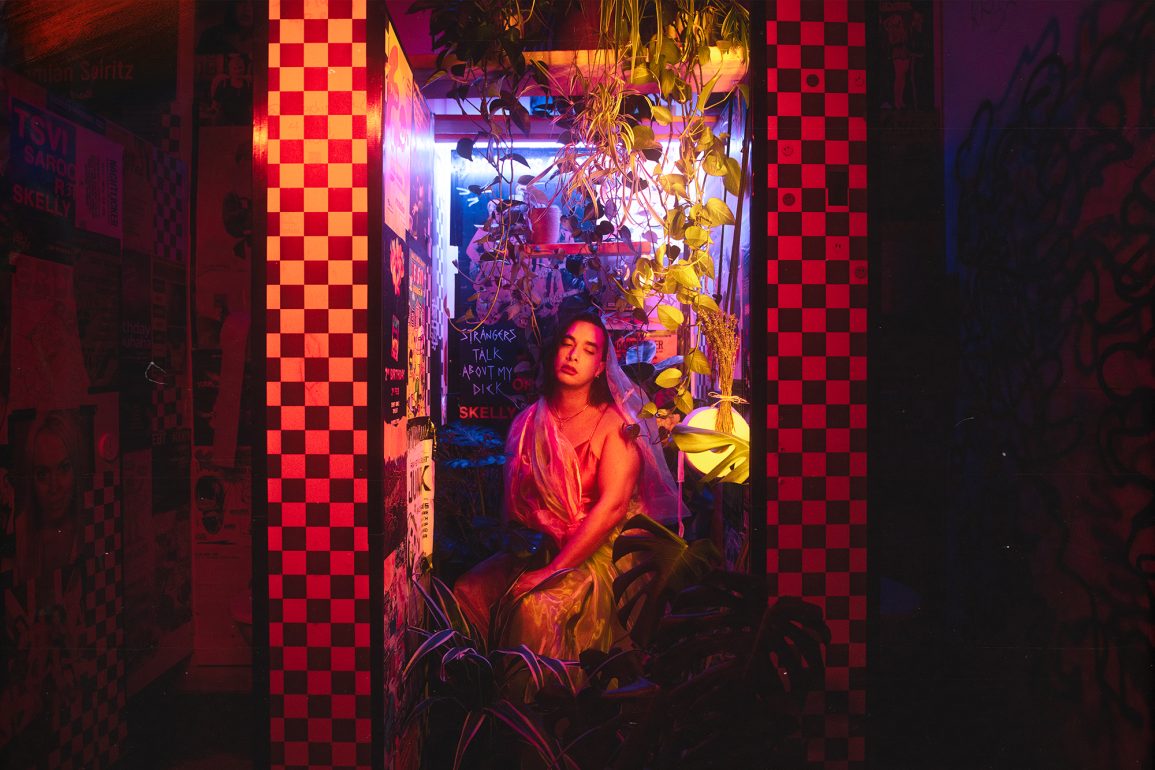
For Dyvr, electronic music has always been about more than the dancefloor. On her debut album Rebuild, the London-based producer, songwriter and performer transforms three years of personal growth into a powerful collection of emotionally charged club music, exploring themes of identity, grief, resilience and community through shimmering synths, euphoric beats and intimate songwriting. Released independently, the nine-track record arrives after a breakthrough run of live performances, including appearances at Glastonbury and Boomtown, and positions Dyvr as one of the UK’s most exciting emerging voices in alternative electronic music.
We caught up with Dyvr to discuss the making of Rebuild, the role of queer community in her creative process, and how electronic music can become a space for healing, solidarity and self-discovery.
Listen to Rebuild while reading the interview below:
Congratulations on the release of Rebuild. As your debut album, but also a record that’s been three years in the making, when did you realise these songs belonged together as one body of work?
Thanks so much! It’s been a bit of a crazy time; I’m not sure it’s sunk in that I don’t need to work on this album anymore!
So I actually set out with the intention of making a larger body of work. I’d released 3 EPs before I started, and each time I’d felt like I was getting closer to something that felt honest, but I also felt like I needed more time with the conversations I wanted to have. Conversations about trans visibility and experience, about vulnerability and power. I wanted my community to feel seen in this project. About 60 songs were written for it actually; it took a long time to figure out which ones to prioritise, and I’m really happy with where it ended up.
How did your personal journey shape the writing process, and were there moments where making the album helped you understand yourself in new ways?
Oh, my album and my transition were happening side by side, overlapping and mixing in with each other. My transition was teaching me to be more real with myself about who I am and what I believe in – which was coming out in the songs. And writing the album was letting me explore my gender journey in a more emotional way, which opened up new ways to be real with myself. They really pulled each other along. It was a beautiful and challenging experience, and I feel honoured to have done it.
The album moves through grief, anger, love and ultimately acceptance. Was it important for you to tell that story chronologically, or did the emotional narrative reveal itself naturally as the record came together?
I think the way I saw it was that each of these songs marked moments in my transition. But within those moments I was always feeling some mixture of emotions. I didn’t have a narrative structure in my mind when I was making it because I truly think I was just in the emotion of it. There’s a lot of ways the tracklisting could have made sense for that reason, but I think I’d just been listening to the demos as they got finished in a certain order and it just felt right by the end of the process.
What is it about electronic music that allows you to express vulnerability in a way that other genres perhaps couldn’t?
I think I could probably express vulnerability in other genres too. A lot of these songs were written on a piano or a guitar and at that stage could have gone in a lot of directions. What I love about electronic music is how it grants you access to your body. We are often so concerned with our emotions being processed internally, academically. But our emotions live in our bodies, and when we connect with our bodies, we have an opportunity to process in a way that is ancient, primal and communal. I’m a big fan of tears on the dance floor!
The new single Cry Baby tackles exclusionary attitudes within feminism while celebrating solidarity across the trans community. What conversations were you hoping to start through that song?
While Cry Baby takes aim at trans exclusionary feminists in a lot of ways, I think the main purpose of it is to actually show some compassion for their position too. The conversation I would like to have is one where we recognise that strict gender roles have harmed everyone. The existence of trans people and especially trans women in this instance suggests that there is and has always been another way to look at what has seemed so fixed and natural. Transness is proof that ideas like ‘man’ and ‘woman’ were created just like language and skyscrapers. It’s my belief that for some women, there is a grief about that which is hard to really look at. That things could have been different; their pain wasn’t inevitable, but decided for them. I think in a lot of ways it’s easier to call a trans woman ‘just a confused man in a dress’ than accept that all genders, yours included, are just a fabrication. Trans people represent a freedom that could help them let go of the pain that currently defines them, but they don’t want to, for fear of their lives losing meaning.
Community seems to sit at the heart of everything you do, from your music to organising events like your London Trans+ Pride after-party. Why has creating spaces for connection become such an important part of your work as an artist?
I simply wouldn’t be here without my community. Without people bravely showing me the way to my own version of self-acceptance, I really don’t know where I’d be. This record is just a love letter in a life that I have devoted to queer and trans people. I believe that queerness is an antidote to many of the problems in our world, and I will work my whole life to nurture spaces that support my community.
You’ve performed everywhere from Glastonbury and Boomtown to Trans Pride events across the UK and Ireland. How have those live experiences influenced the way you approach writing and producing music?


I think seeing how people respond is always a helpful thing. But also, I am the target market for my music! In a lot of ways, I know what will land in most rooms. I always produce with the dance floor in mind, so in a way yes, but it’s more abstract.
Your sound has been compared to artists like Oliver Sim, RY X and Elder Island, but Rebuild still feels incredibly personal. How would you describe the sonic identity you’ve been building with this project?
Outside of the creative, emotional growth I experienced on the record, there was also a separate journey going on within my understanding of music production. I had very little production experience when I started the record, and I produced everything myself. In a lot of ways, the sound of the album is the sound of me learning to produce. There are imperfections, odd little solutions and unorthodox techniques all over the place. I was insecure about this for a long time, but now I just hear something honest and unique. I think that’s why it feels so personal.
What have been some of the biggest challenges and rewards of taking that independent route?
In a lot of ways I set out to make a style of album that hasn’t really been made before. I don’t really know of anything else like it, which is great, but also means that I spent a lot of time second-guessing myself and worrying that I was making bad choices. I’d say the reward is being able to accept it for what it is – I’ll likely never make anything like this again, and it feels good to know that this album is exactly what it needed to be.
Now that Rebuild is finally out in the world, what do you hope listeners take away from it, and what does the next chapter of Dyvr look like?
More than anything, I hope that trans people see themselves in this album. It’s an album I wish I had when I started my journey, and I want my community to know that this is for them. Right now I’m running around playing a lot of shows in the UK and Ireland, which is filling me with joy. In terms of what comes next, all I know is that I want to write with other people. This album was made in such a solitary way, and I just want other trans people’s emotions and talents in what I’m doing now. I’m excited to make something completely different next!
Follow Dyvr:
Facebook | Instagram | Spotify