

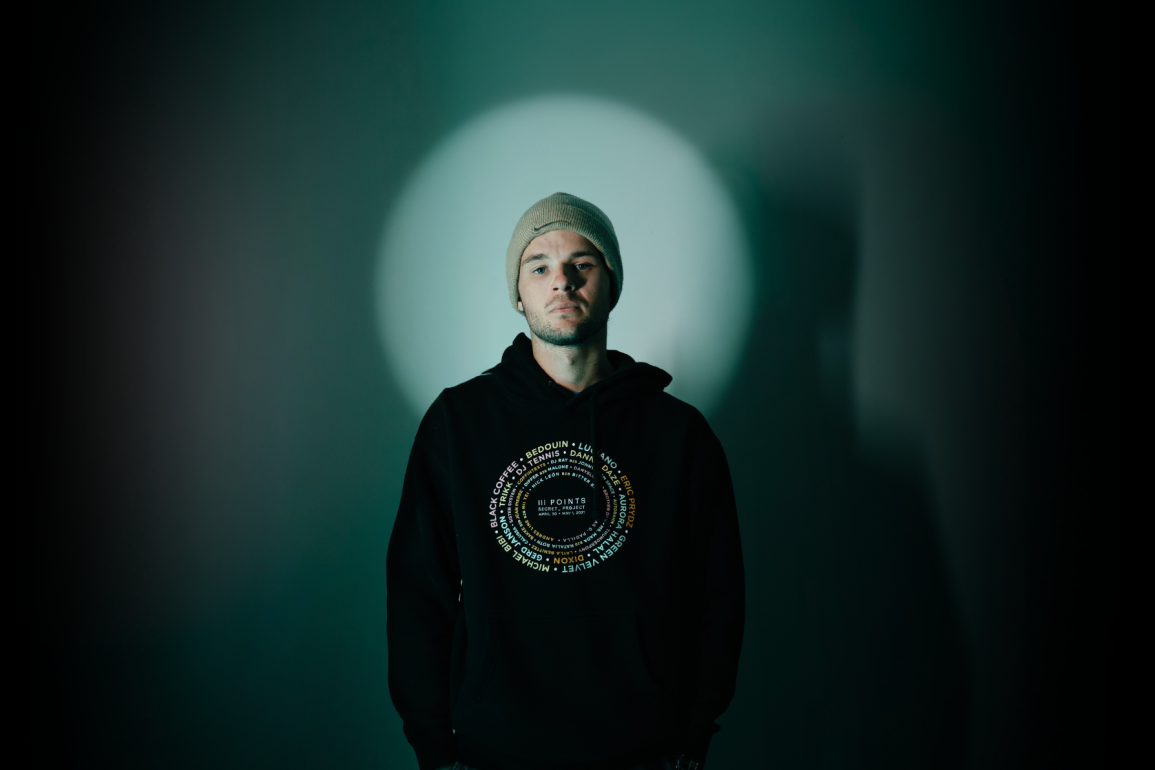
From starting as a pianist to discovering music production on FL Studio at 14, UMAEDO has spent much of his life following an instinct to create rather than simply reproduce. Born from his early experiments with electronic music, the project has since evolved into a distinctly groove-driven take on house and deep house, built around hypnotic rhythms, warm textures and basslines that often form the starting point of his tracks.
Since his first public performance during his teens, UMAEDO has gone on to earn support from the likes of Mau P, John Summit, Kungs and Joseph Capriati, while his breakout track ‘Body Moving’ surpassed 5.8 million Spotify streams. We recently caught up with him to discuss, among other things, a new chapter defined by bigger releases, new collaborations and an increasingly energetic presence behind the decks.
Listen to ‘Body Moving’ while reading the interview below:
You spent seven years playing piano but found yourself more interested in creating your own melodies than following sheet music. How did that early relationship with the piano shape the producer you became?
Honestly, I was pretty bad at reading sheet music, haha. I spent seven years playing piano, but I was always much more interested in creating my own melodies than actually following the notes on the page. I think that’s what naturally pushed me towards producing. The piano gave me a really good ear from a very young age. I became very sensitive to melodies, harmonies and how different notes sounded together. Looking back, I think that early experience still plays a big part in the way I make music today.
You started teaching yourself production on FL Studio at 14 and played your first public gig at just 17. Looking back, what do you think gave you the confidence to start so young?
Honestly, my beginnings with production were pretty on and off. I was only 14, so I was way too young to sit down and practice for ten hours a day, haha. I would just open FL Studio when I felt like it, make a melody or a little idea, and then close it and move on. I never really forced myself to practice. I was mostly interested in making melodies and little pieces of music. The technical side, especially mixing, didn’t interest me at all for a long time, haha. It was really when I switched to Ableton that I started taking production seriously. Something just clicked for me, and I started spending much more time making music and figuring things out for myself. That’s when I really started developing my sound and eventually felt confident enough to share it with people.
How would you describe the UMAEDO sound to someone hearing your music for the first time?
The UMAEDO sound is warm, uplifting and very bass-focused. There’s always a sense of movement to it, like going somewhere or travelling. I’m really into warm melodies and basslines that have a lot of groove. I want my music to make you feel good and want to move, but also take you somewhere. I don’t really want to put too many rules around it. As long as there’s a groove and it makes you feel something, it can fit into the UMAEDO sound.
Your influences range from Dennis Ferrer and Ferreck Dawn to Tchami, Malaa and even Kendrick Lamar. How do those different influences come together when you’re actually in the studio?
Tchami and Malaa were actually my first big inspirations. That’s what got me into electronic music in the first place. But as I grew as an artist, I started digging deeper into house music and became increasingly influenced by artists like Dennis Ferrer, Ferreck Dawn and Claptone. Kendrick Lamar is a bit different. I’m more inspired by the way he uses drums, sampling and sequencing, and especially the bass grooves on To Pimp a Butterfly. I really like the way the bass and drums interact in his music. So I guess all these influences just come together naturally when I’m making music. I’m not trying to sound like any of them, but they’ve all influenced me in different ways.
You moved from France to London in 2023 to study Sound Engineering & Music Production at Point Blank. How did living in London change your perspective on house music and your own artistic identity?
Moving to London was a big turning point for me. Coming from France, I already loved house music, but being in London made me really dive into the culture around it. I was surrounded by DJs, producers, clubs and people who were just living music. It also made me understand more clearly what I wanted to do. I discovered so much new music, played in different places and met a lot of people from the scene. It made me realise what I liked, what I didn’t, and what felt natural to me. I think London helped me stop worrying about fitting into a certain sound and just focus on making music that feels like me.
There’s an interesting contrast between your productions and your DJ sets. How do you approach the two sides of your artistry differently?
There’s definitely a contrast between the two. My own tracks are usually softer and more melodic than what I play in my DJ sets. I think that’s simply because when I’m in the studio, softer and more musical stuff comes naturally to me. When I’m DJing, I can show a different side of myself. I like playing more energetic, bass-heavy and sometimes darker tracks. It’s more about the energy in the room and what I feel like playing in that moment. I don’t really see them as two different things though. It’s just two different sides of me.
‘Body Moving’ feels like a particularly important moment in the UMAEDO story, surpassing 6 million streams. At what point did you realise that the track was going to be something bigger than you initially expected?
When I posted the video on TikTok, I honestly had no idea the track was going to go viral. I was just chilling by the pool, and for once, actually enjoying my own track. At first, I just started seeing people asking for the track, and then more and more people were making videos using it, singing, dancing, or doing their own thing with the song. It just kept growing, and eventually there were more than 210,000 videos using the track. At the same time, some of the biggest creators were starting to use it too. Then several major labels started reaching out to me. That’s when I really realised that this was becoming something much bigger than I had expected. It was pretty crazy because I never planned for any of that to happen. I’ve never really been a “content guy”, haha. I just posted the track, and suddenly it had a life of its own.


You’ve since played across Mexico, Thailand, Miami, Los Angeles, London and Morocco. What’s something you’ve learned from playing to international dancefloors that you couldn’t have learned in the studio?
I think the biggest thing I’ve learned is that you can’t play the same way everywhere. Sometimes you play a track thinking it’s going to work and it doesn’t, and sometimes a track you didn’t expect gets everyone going. You learn to trust your instinct and react in the moment. You can’t really learn that in the studio. In the studio, everything is under your control, but on a dancefloor, you have to react in real time. And honestly, playing in different countries made me realise how universal music is. You can be on the other side of the world and people still connect with the same groove.
If you could go back and speak to the 14-year-old who had just opened FL Studio for the first time, what would you tell him?
I’d tell him: don’t overthink it, just enjoy making music. You have no idea that a few years from now, your first release is going to be signed during COVID by Noir Sur Blanc, a respected French electronic label, after a live demo listening session on Twitch. So don’t worry too much about whether what you’re doing is good enough or where it’s going to take you. Just keep making stuff because you love it. You never know where it can lead.
Beyond the next wave of releases, what’s one thing you still want to achieve over the next few years?
I think the main thing is to never lock myself into one specific genre. I want to keep evolving, trying different things and making whatever feels natural to me at the time. But whatever direction I take, I always want to keep my groove and that feeling of taking people on a journey with my music. I also want to keep collaborating with artists from around the world. Working with people from different cultures and backgrounds is a big part of what keeps me open-minded and inspired. That’s probably the most important thing for me: keeping that part of myself, even if the sound changes.
Follow UMAEDO: